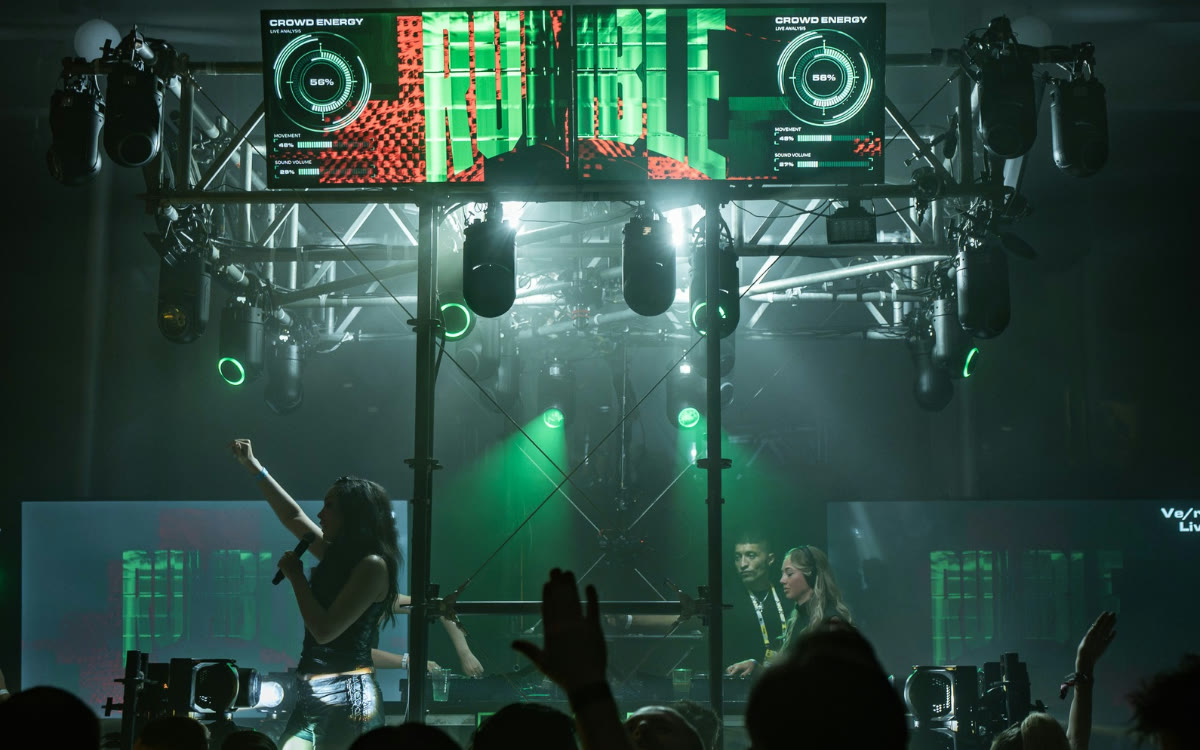
A live score of crowd energy that judged a DJ battle during Amsterdam Dance Event
Rumble runs DJ battles where the crowd picks the winner. For its first live show, during Amsterdam Dance Event 2026, MOHARA built the system that measures how excited the room is, in real time, and feeds it into the show.
- Sector
- Live events and music
- What we built
- A live crowd-energy score from cameras, microphones and floor sensors, plus DJ handover and show control
- Timeframe
- Research from April 2026, kickoff in May, test nights in September, first live show on 22 October 2026
- Outcomes
- Ran a full live show during ADE first time, with every DJ handover working and the crowd's score on the big screen after every battle.
The client
Rumble is a new live format that takes the DJ battle and makes the crowd the judge. Two DJs go head to head, and the winner is the one who gets the biggest reaction from the room.
What they were going after
That only works if the reaction is real, visible and fair. Rumble wanted the crowd's energy measured live and put on the big screen as the heart of the show. Its first live show would be during Amsterdam Dance Event, one of the biggest weeks in dance music. The score had to be one the crowd trusted and the production team could build visuals around. And if the handover between DJs failed, the room went silent, so it had to work first time in front of a paying crowd.
What we built.
Reading the room
Cameras, including infrared, that measure crowd movement without being fooled by stage lighting; microphones tuned to pick up cheers and keep the music out; and floor sensors testing whether movement can be felt through the floor.
The Tower
An on-site machine that combines every signal into one live score.
Running the show
The Switch, which hands over from one DJ to the other, from tablet to tower to sound desk; an operator dashboard to start and end battles and apply overrides; and live feeds of the score, the leading DJ and the biggest moments to the visuals and show control.
How we worked.
We went from first research to a live festival show in six months, and tested in a real club before going anywhere near the festival. Test nights at a renowned London club in September showed what needed fixing, and those fixes carried the live show.
The big call was to leave wearables for later and measure the room with fixed sensors. Nobody in the crowd had to download or wear anything, and nobody is identified by the cameras or microphones.
On the night.
Audience reaction tech key to Rumble's bet on DJ battle format

Have a problem like this one?
The team that built this for Rumble is the team you would work with. Tell us what you are trying to solve.